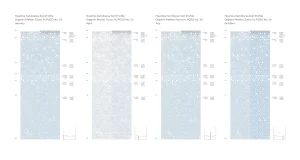
The Garden of the XXI Century (JSXXI) is a research project located in the town of Huertos Familiares, in the municipality of Tiltil, 40 km north of Santiago, Chile. This area is marked by prolonged drought, caused not only by declining rainfall but also by the unequal management of water resources and the accumulated impact of industrial and mining activities. The drought has intensified over the past 20 years, as shown by the Gaussen diagram, which relates rainfall and temperature in order to identify dry periods and, in the case of this area, reveals a sustained process of environmental degradation. These conditions fall under what has been termed extractive droughts (Tironi and Acuña 2022),[1] a phenomenon in which water scarcity is understood as the result of political and economic processes that reconfigure the territory. This situation is compounded by the recurrence of fires in recent years, further intensifying the fragility of a landscape composed mainly of grasslands and thorn scrub (Vachellia caven) and historically shaped by extensive grazing.
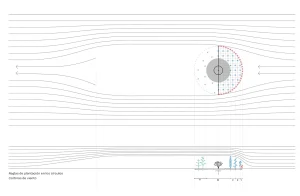
The Garden of the XXI Century proposes a critical alternative to the extractive logics and neoliberal policies that have shaped Tiltil’s socio-ecological foundations. Rather than operating through a closed planning model, the project is grounded in a territory-based practice that recognizes and values local knowledge and existing ecological processes. This approach understands the area as a living, relational system in which human and non-human forms of life co-construct the landscape. In doing so, it displaces anthropocentric perspectives that reduce territory to a resource to be controlled. Design is not imposed through form; instead, it emerges from observing and listening to the soil, existing vegetation, wind, and fire as agents capable of guiding the project.
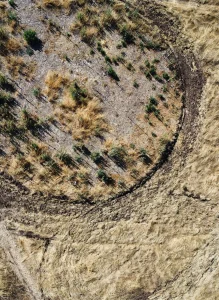
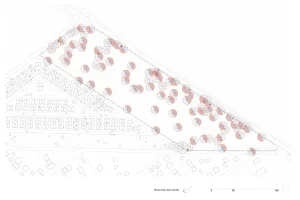
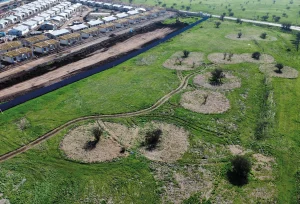
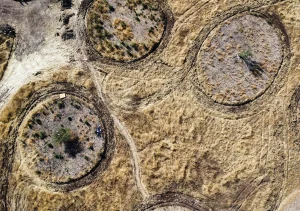
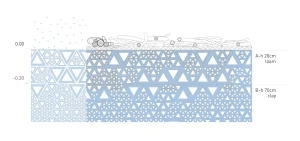
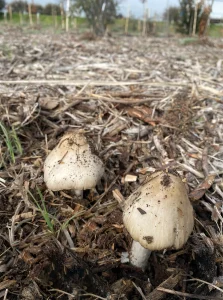
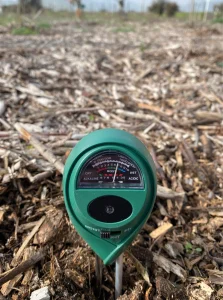
The proposal is structured around the application of gardening practices to extensive, depleted soils. The 3.4-hectare site is being progressively covered with pruning waste collected in collaboration with the community, helping to protect the soil, retain moisture, and reduce fire risk. The design is organized around circles defined by the location of the thorn scrub and the reach of their root systems. With an estimated budget of US $70,000, the project aims to cover 36 circles; to date, 9.160,92 m2 of ground cover has been completed, reflecting increased efficiency as a result of the knowledge accumulated since the project began in early 2023.
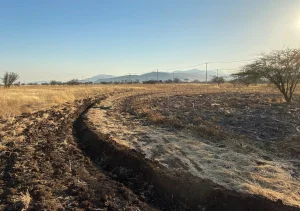
The project is developed in collaboration with local organizations and transmits rules through community workdays and hands-on practice. Nearby fires in 2023 and 2024 reinforced the need to implement protection strategies such as perimeter plowing and the creation of windbreaks. The community has now formed the JSXXI Collective, which is responsible for the project’s care and maintenance. The Garden of the XXI Century is thus a long-term evolutionary process: a socio-ecological alternative for Tiltil and a new form of territorial management based on collaboration, listening, and time.
[1] Acuña, Valentina, and Manuel Tironi. 2022. “Extractivist droughts: Indigenous hydrosocial endurance in Quillagua, Chile”. The Extractive Industries and Society 9: 101027. https://doi.org/10.1016/j.exis.2021.101027