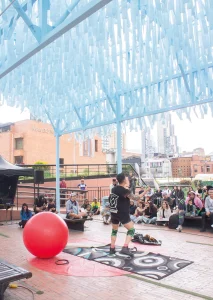
The Memory of the River is a project located at the intersection of public art and ephemeral architecture, conceived as a transitory cultural infrastructure capable of reactivating urban spaces throughout the city of Bogotá. In this sense, it embraces temporary—rather than permanent—intervention as a strategy to decentralize cultural activity and enable different neighborhoods across the city to host their own events. The initiative was developed by the Secretariat of Culture, Recreation, and Sports (SCRD), under the leadership of Secretary Santiago Trujillo and Diego Parra, Director of Art, Culture, and Heritage. An important role was also played by the Secretariat’s Subdirectorate of Infrastructure and Cultural Heritage, led by Edgar Figueroa and a team composed of Edgar Bernal, Emmanuel Guerra, Juliana Mendoza, Diego Rodríguez, and Juan Sebastián Robayo.
The project takes the city’s water systems as a conceptual reference, particularly its rivers—natural infrastructures that were historically pushed aside as the city expanded. Characterized by their dynamic nature and ability to adapt to changing conditions, these systems served as the basis for a modular, flexible architectural design that can respond to diverse spatial contexts without imposing a fixed or permanent form on the urban landscape.
Based on this logic, The Memory of the River helps move beyond traditional anthropocentric conceptions of architecture that reduce it to the production of permanent landmarks imposed on a place, transforming it irreversibly. By contrast, the project is proposed as an experiment that questions whether public investment should be limited to permanent infrastructure, or whether it might also support medium and large-scale mobile structures. These infrastructures are not imposed on the sites they occupy; rather, they adapt to them, enabling the decentralization of cultural activity and leaving collective memory as the only trace of their presence.
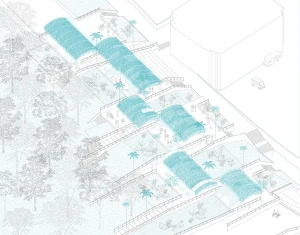
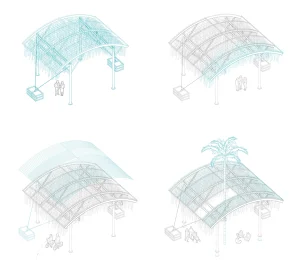
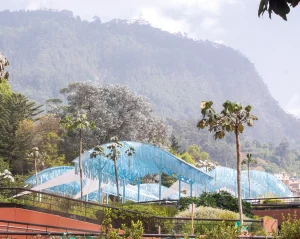
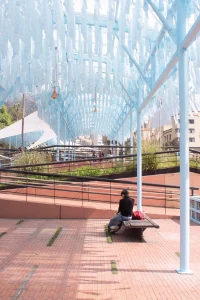
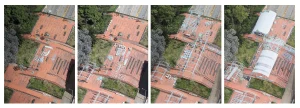
Based on these guidelines, the technical team—composed of El Líder S.A.S., INGEACERO, and Alsar-Atelier—developed a module measuring six meters in length, eight meters in width, and five meters in height, with a vaulted elevation that allows it to expand in a single direction. The construction system, based entirely on dry joints, allows the modules to function as components that can be assembled and dismantled, and installed in streets, squares, or parks without permanently altering their existing conditions.
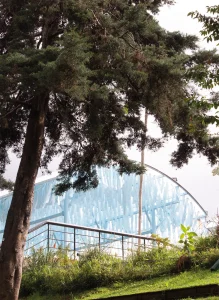
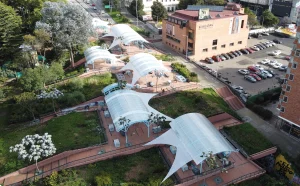
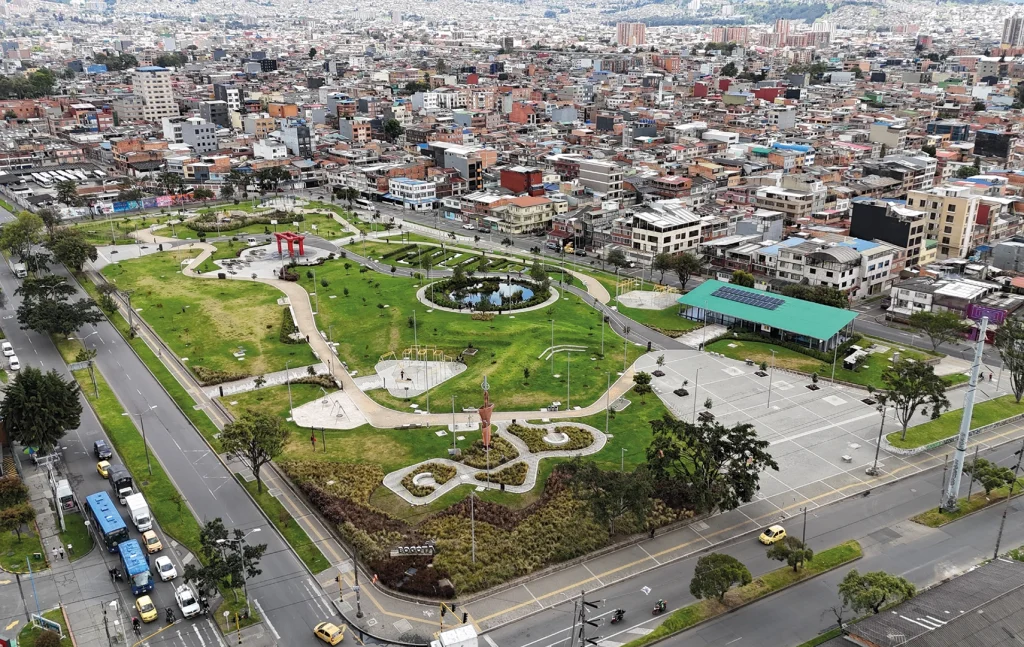
This logic of not obstructing, but rather adapting to the urban and natural landscape, introduces a multispecies awareness into the project’s design. The infrastructure avoids modifying or eliminating elements that may serve as habitats for non-human species. A concrete example of this approach can be seen in the project’s implementation in Bicentennial Park, where the modules were built around pre-existing vertical elements—specifically yarumo trees—allowing them to be assembled and later dismantled without affecting these living organisms.
Additionally, The Memory of the River helps shape multispecies urban environments through a spatial ambiguity between the public and the private. As a roof structure designed to host a wide range of cultural activities, the boundary between interior and exterior is defined not by walls or doors, but by the projection of the roof itself. This openness allows people to take part in cultural activities alongside their pets, unlike many traditional cultural venues, where rigid boundaries often exclude non-human species.
Rather than merely a temporary infrastructure, The Memory of the River is conceived as a reversible, responsive form of architecture—one that moves with the rhythms of the city and proposes a less extractive, more adaptable, and multispecies relationship between culture, architecture, and urban space.