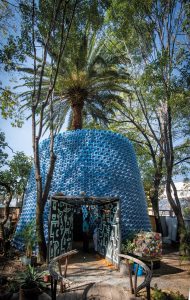
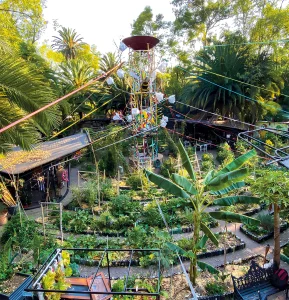
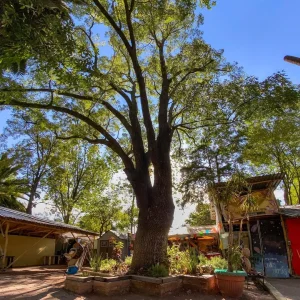
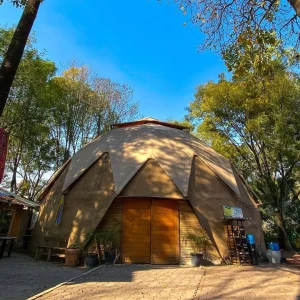
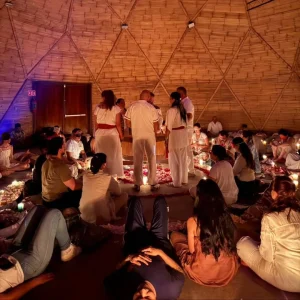
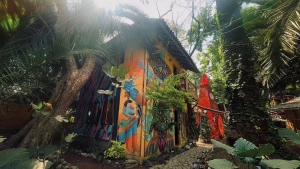
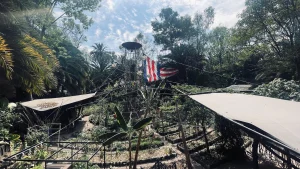
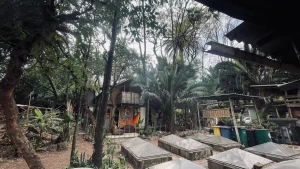
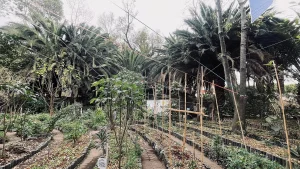
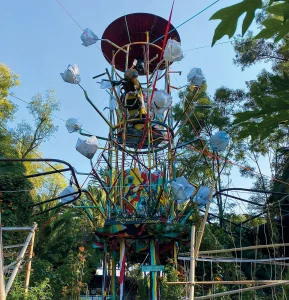
Huerto Roma Verde is a biosocial laboratory for good socio-environmental practices. Through art and culture, it develops tools for citizen empowerment, strengthens the social fabric, and promotes local action in response to the environmental emergency.
It emerged in early 2012 on a plot of land in Mexico City’s Roma neighborhood that had remained abandoned for more than 27 years after the 1985 earthquake. The initiative to reclaim the site was led by a civil association founded by Francisco Ayala, who brought friends and neighbors together to create a community garden. Over time, numerous individuals and organizations began contributing ideas, projects, and initiatives, transforming Huerto Roma Verde into an international model for urban regeneration. The project is grounded in three core principles—Indigenous knowledge, social biology, and permaculture—which together shape the regenerative process known as regenerative hikuri.
Today, Huerto Roma Verde is a space that promotes decentralization, self-management, pluridiversity, and a multispecies vision, grounded in the recognition that we are witnessing the emergence of a new geobiosystemic paradigm.
The space receives around 250,000 visitors each year and hosts more than 450 cultural and artistic activities. It functions as an intergenerational center for socio-environmental innovation that, above all, fosters a shift in perspective. Here, people learn not only to grow their own food and medicine and to explore alternative forms of housing, but also to reflect on new forms of participatory governance aimed at decolonizing power and integrating decision-making across multiple levels.
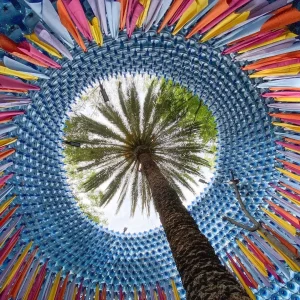
The Huerto has the most comprehensive community recycling center in the country, receiving more than 20 different types of solid waste, as well as organic matter. It is also connected to more than 380 civil society organizations and universities and is home to 15 productive biosocial cells, including herbalism, ceramics, carpentry, traditional toys, music, community radio, textiles, and handicrafts. Every Wednesday, local producers from the conservation land of the Valley of Mexico are brought together at an agroecological market. One of its priorities is to promote food security and sovereignty by supporting initiatives that improve soil health and encourage agrochemical-free cultivation.
The project is operated by La Cuadra A.C., an organization that promotes and develops socio-environmental regeneration projects and has contributed to a wide range of initiatives in Mexico and abroad. The Huerto was awarded first place in the World Green Awards in the Social Cohesion and Inclusive Communities category. It was also the first Homes for Humanity site in Mexico and has received several distinctions, including recognition as a Sanctuary of Peace and Life by the Ecovillage Network, the Environmental Quality distinction from Profepa, recognition from the International Solid Waste Association, and the Culturally Responsible Institution seal.